
Cost to Win a Job: Why a Lead Price Is Not a Cost
Why a lead price only becomes a cost after you divide by your close rate, how to find your own close rate, and what changes when it moves.
Naibrly ResearchPublished
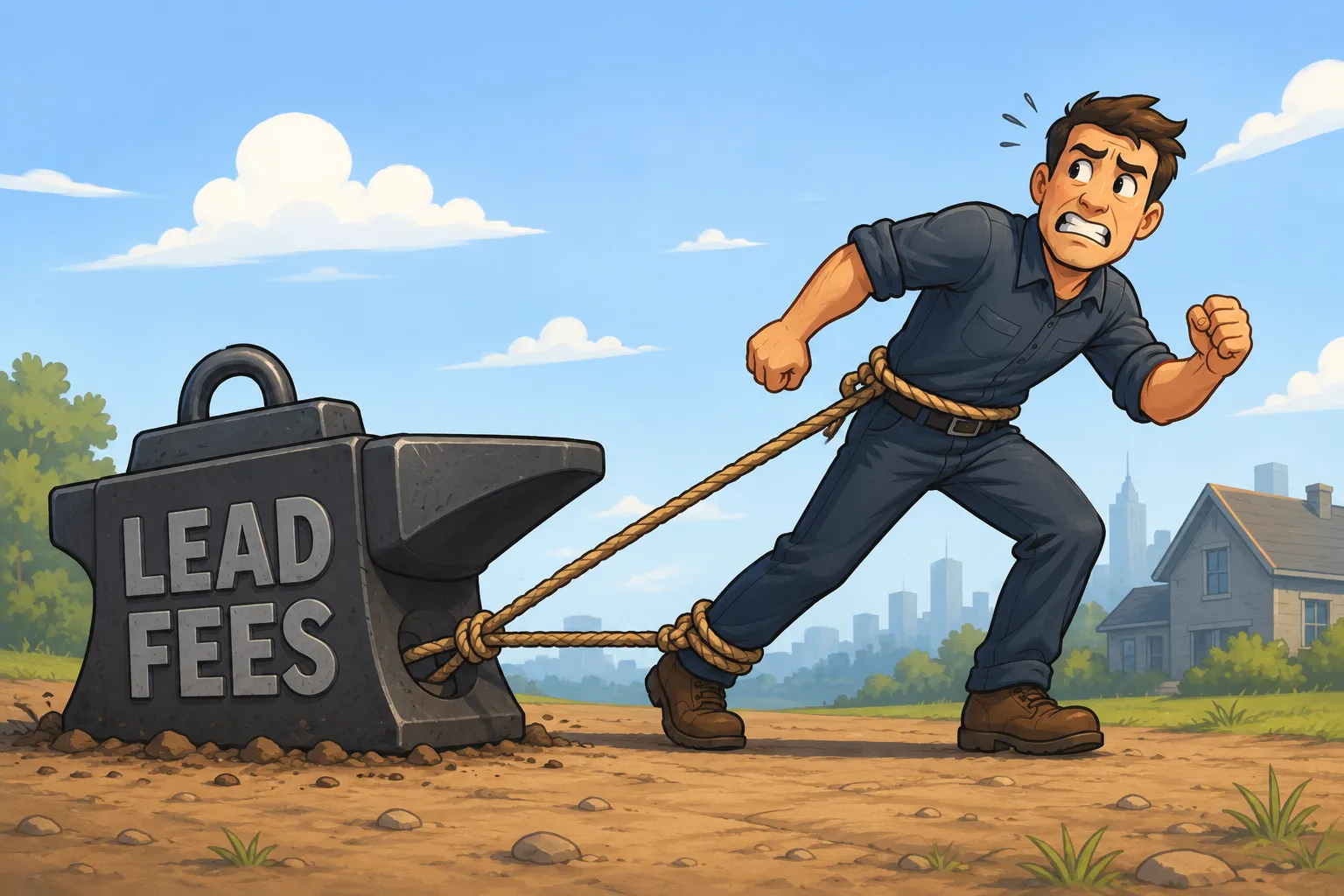
A lead price is not a cost. A lead price divided by your close rate is a cost.
Everything else in this post follows from that sentence, and almost every argument about whether a home service platform is expensive comes down to which of the two numbers the person is holding. The platform quotes the first, because that is what it bills. Your business runs on the second.
The one division that turns a price into a cost
You pay for every opportunity you take and you finish only some of them. The ones you did not win are not free, and they do not vanish. Their cost is carried by the jobs that did close, because those are the only jobs there are to carry it.
At a 25% close rate, that means four paid opportunities behind every completed job. Not one. The cost to win a job is four times the price of a single lead, and that is the number your quote has to cover.
The Naibrly fee calculator does that division for each platform it tracks and prints the result as the cost to win one standardized job. Every lead price feeding it is labeled as an estimate with a checked date, because a competitor's pricing varies by market, category and job size and pretending otherwise would make the page less useful, not more.
Why the close rate is the number you are betting on
Consider what a per-lead cost actually is. You are paying a fixed amount for an outcome that is uncertain, and the price of the outcome is set by how often you convert. That is a bet, and you are on both sides of it.
This is not a criticism of the model. It is a fair description of it, and the model has a real strength that follows directly: the provider who answers within minutes, quotes clearly and follows up is buying jobs at a genuine discount to the provider who does not, from the same platform at the same price. A per-lead cost rewards operational discipline more directly than almost anything else you can buy.
The catch is symmetrical. When your close rate slips, the cost per won job rises immediately, and it rises without any invoice looking different. Nothing on the bill changes. Your margin just quietly moves.
How to find your own close rate
Most providers have never calculated this, which is the single biggest reason lead budgets get misjudged. It takes about twenty minutes.
- Pick one platform and one full quarter. A month is too short: work quoted in the last week of it closes in the next one and the numbers lie in both directions.
- Count the opportunities you paid for in that quarter.
- Count the jobs from those opportunities that you completed and were paid for.
- Divide the second by the first. That is your close rate on that platform.
- Divide the total the platform charged you by the number of completed jobs. That is your real cost per won job, in dollars, with no assumptions in it at all.
Step five is worth doing even if you skip the rest, because it needs no modeling. It is two figures off your own statements, and it is the only version of this number that is definitely true for you.
Three things that make a close rate look better than it is
The arithmetic is easy. Getting honest inputs is where it goes wrong, usually in one of three ways.
Counting quotes instead of opportunities. If you paid for an opportunity and never managed to reach the homeowner, it still counts in the denominator. Dropping the ones you never quoted turns a close rate into a quote-to-close rate, which is a different and considerably more flattering number.
Counting the job you won six months later. Attribution drifts generously over time. Fix the window before you start counting, and keep the same window on both sides of the division.
Counting revenue instead of completed work. A job that was booked, then canceled, then partially refunded is not a win. If the money did not stay, it does not belong in the numerator.
None of these are dishonesty. They are what happens when you count from memory instead of from statements.
What changes when the close rate moves
The relationship is not gentle, because it is a division rather than a subtraction.
Take a fixed lead price and improve your close rate from one in five to one in four. Your cost per won job falls by a fifth. Nothing was renegotiated and no price changed anywhere; you simply need fewer opportunities to produce the same job. Slide the other way, from one in four to one in six, and the cost per won job rises by half.
That is the same lead, at the same price, costing wildly different amounts depending on a number the invoice never mentions. The fee calculator makes this visible by printing one estimated lead priced at three different close rates side by side, which is the clearest way we have found to show that a lead price on its own tells you almost nothing.
Two practical notes. Close rates differ sharply by trade, so a figure a friend in another category quotes at you is not transferable. And they differ by lead source within the same business, which is why the calculation is worth doing per platform rather than once across everything.
Where a commission behaves differently
On a commission or transaction fee, the fee comes out of completed work. There is no multiplier, because there is no charge on the jobs you did not win.
That does not make quoting free. An hour spent on a quote you lose is still an hour. What changes is that the hour is the entire cost of losing, rather than the hour plus a charge, and the cost of winning is a percentage you can state in advance instead of a bet on your own conversion.
Naibrly's Core plan is 5% of completed jobs plus $15 a month, and those are published rates rather than estimates. The reason to mention it in a post about close rates is narrow and specific: on a percentage of completed work, your close rate stops appearing in your cost of acquisition at all. It still governs how much of your week you spend quoting, which is a real cost and one worth managing. It just stops being a line item.
Which model that favors depends on your volume and your average ticket, and that comparison has its own post: pay per lead versus commission. The per-platform figures are on the marketplace fees page, with break-even volumes and checked dates.
Cost per acquisition, in plain language
Every other industry calls this cost per acquisition, and there is a reason it is worth borrowing the term. It forces the comparison to happen against your profit rather than against the platform's price list.
The test that matters is what share of the gross profit on a typical job your acquisition cost consumes. Not a share of revenue, which flatters high-ticket work and hides the problem on low-ticket work. A recurring service with a modest ticket and a thin margin can be destroyed by an acquisition cost that a large install would barely notice.
So the sequence is: what do you keep on an average job after materials, labor and travel; what share of that are you willing to spend to get the next one; and does the cost per won job you calculated above fit inside it. If it does not, the answer is either a better close rate, a different ticket size, or a different fee model. Those are the only three doors.
The number that changes the verdict: repeat work
There is one honest defense of a high cost per won job, and it is worth stating because it is often the right answer.
If a job you win becomes a customer who books you again, the acquisition cost was paid once and is carried by every visit after it. A recurring service that retains a customer for two seasons has effectively halved the cost of getting them. That is why the same cost per won job can be indefensible for one-off work and perfectly sensible for a route you are building.
So run the division twice. Once as cost per won job, which is what the platform charges you. Then once as cost per retained customer: the same total charges divided by the number of customers from that platform who booked you more than once. The gap between those two figures is the value of your follow-up, and for most providers it is larger than any fee difference they were arguing about.
That also reframes what to look for in a platform. A charge per opportunity is priced per transaction whether the customer returns or not, so retention accrues entirely to you. A percentage of completed work keeps taking its share on every repeat visit, which is the honest cost of that model and belongs in the comparison.
Run it on your own platform
Start with the version that needs no assumptions: total charges last quarter, divided by jobs completed last quarter, per platform. Write the figures down somewhere you will see them again.
Then compare them against the fee calculator, where you can pick a platform and set your monthly volume, and against the per-platform breakdowns on Naibrly versus Thumbtack and Naibrly versus Angi, which carry the estimate hedges and the dates on every competitor figure.
If the number you find is larger than you expected, that is the normal outcome, and it is more useful than the number you were assuming. Start as a provider if a percentage of completed work suits your month better than a charge per opportunity.
Common questions
- What does a lead really cost after your close rate?
- A lead's real cost is its price divided by the share of leads you close, so at a 25% close rate the cost to win one job is four times the price of one lead. That division, not the headline price, is the figure that belongs in your pricing and in any comparison between platforms. Naibrly's fee calculator prints the cost to win one standardized job for each platform it tracks, with competitor lead prices hedged as estimates and dated July 2026.
- How do I calculate my close rate?
- Count the opportunities you paid for in a full quarter, count the jobs from those opportunities that you completed and were paid for, and divide the second number by the first. Use a quarter rather than a month so that work quoted late in one period and closed in the next does not distort the result. Most providers who run this for the first time find a lower number than they expected, which is the point of running it.
- What close rate do I need for buying leads to be worth it?
- Buying leads pays off at the close rate where the lead price divided by that rate stays comfortably below the gross profit you keep on a typical job, which means the answer depends on your margin as much as on the platform's price. Work it backwards: take what you actually keep on an average job, decide what share of that you are willing to spend on acquisition, and the close rate you need falls out of the division. Per-platform versions of this math sit on the Naibrly comparison pages.
- What is a good cost per acquisition in home services?
- There is no single benchmark for cost per acquisition in home services, and the useful test is not cost per acquisition as a share of revenue but as a share of the gross profit you keep on the job. A high-ticket install can absorb an acquisition cost that would erase the margin on a recurring low-ticket service entirely, so the same dollar figure can be healthy in one trade and fatal in another. Compare against your own kept profit rather than against an industry average.
- Does a commission platform have a cost per won job?
- A commission platform has a cost per won job, but it has no close-rate multiplier, because the fee comes out of completed work rather than out of delivered opportunities. That makes the figure knowable in advance as a percentage of the job rather than a bet on your own conversion. Naibrly's Core plan is 5% of completed jobs plus $15 a month, published rates as of July 2026, and nothing is charged for a quote that does not become work.
- Why is my cost per lead lower than my cost per job?
- Your cost per lead is lower than your cost per job because you pay for every opportunity and finish only some of them, so the charges for the ones that did not close are carried by the ones that did. The gap between the two figures is exactly your close rate. A platform quotes the first number because that is what it bills; the second is the one your pricing has to survive.